Posts

Which Famous Archaeologist Are You? Take Our Quiz!

Quiz Powered By ProProfs

Back at Berkeley: 14th Time Lucky

Image
We’re back to begin our 14th year at Berkeley! Before the digging can start, health and safety duties will be performed, the steps leading in to the trench need to be cleared, areas not ready to be excavated will be cordoned off and the trench will be thoroughly weeded; probably not as exciting as you might expect but absolutely necessary nonetheless.  Returning students can’t wait to get stuck in. Second year student Phoebe says that she finds the excavation process very satisfying and is ready to do meaningful work, in addition to further developing her skills with larger tools such as mattocks. Julia, also second year, is eager to get to grips with the hands-on aspect of excavation and get muddy, and is also looking forward to the camaraderie.  As we start this years’ excavations, the bottom of the trench nearest Berkeley High Street has been dated as Medieval, probably c. 13th to 14th century. At this end the focus will be on the two buildings, one of which has be...

Archaeology and Poetry: The Lansdown Poetry Workshop

Image
Last week, the excavation received a visit from the Lansdown poetry workshop, an informal network of Bristol-based poets who meet once a month in The Lansdown, Clifton. The tour was organised by recent Bristol graduate, Robert Beavis, to provide an educational and inspiring experience, in the hope of stimulating creative responses to the academic environment. Although the processes of archaeology and poetry may seem worlds apart, they share many similarities.  Archaeology makes the past present; poetry makes the past as experienced by somebody else present for the reader. Poetry can be  can be used to reflect on the past, much in the same way that archaeology provides us with a physical interpretation of history. There is also a romanticism to archaeology, in the ruins of buildings or holding an artefact for the first time in hundreds of years, that can be seen in many poetic styles. Robert wished to highlight this and inspire the visiting poets to create their own artis...

Humans of the Trench - Part III

Image
Our visiting scholars shared their views of the archaeological dig! We really loved welcoming them on site and were impressed with their hard work and dedication. Bridgette 1) How has the Berkeley dig surprised you? The variety of things that can be found has surprised me — yesterday we found animal bone fragments, joints and horse teeth! 2) Have you made any new friends? Mia and Shauna! We’ll definitely stay in contact and we’re going to friend each other on Facebook. 3) Do you think about archaeology differently now? Yeah I do - it’s way more tangible now (pun intended). 4) Describe your dig experience in 3 words Intriguing, useful and teamwork — it’s all about working together. Amber 1) How has the Berkeley dig surprised you? I didn’t think I would find bones, so it surprised me that we found pre-Roman animal bones on our first day! And it’s a lot more work than I thought   2) Have you made any new friends? Yeah I...

Humans of the Trench - Part II

Image
After the success of the first Humans of the Trench , we thought you’d like to meet a few more of the many students we have here at the Berkeley dig and what they have enjoyed about their time with the project. Abi Abi is a first year student who enjoys mattocking and how effective it can be to get to the archaeology underneath. She loves how it can break through layers of the past. Abi particularly likes the discovery that comes with working outside in the field. She has found a number of shiny animal teeth and has been impressed how something so old still looks so new. The best bit of archaeology and working at Berkeley has been applying that knowledge from lectures. Mark Mark is a first year student who found a nearly complete sheep jaw and the butchery evidence gave him a real feeling of connection with people of the past. Mark loves the whole process of archaeology. He loves being able to take part in everything from surveying and digging to processing fi...

Berkeley Castle Archives: an interview with David Smith part 2.

Image
Following on from our blog post yesterday, students Tatchiana and Hattie discussed conservation issues facing Mr Smith as an archivist and his other interests. What do you personally consider to be the most interesting research that has been conducted using anything from the archives? Is there anything which stands out as particularly significant?   There have been several pieces of research that I’ve been really impressed by. The doctoral theses really are the tops because people have the time to really get into the documents in depth, and also read around them and compare them with documents in other repositories. The study of the development of the estate in the eighteenth century based on the Manor of Ham is a brilliant piece of work. He hasn’t quite finished writing it, but it will be brilliant, and he’s made a couple of presentations at Berkeley on what he’s discovered. And the medieval studies have been marvellous. [Bridget Wells-Furby] wrote an economic study of the B...

Berkeley Castle Archives: an interview with David Smith part 1.

Image
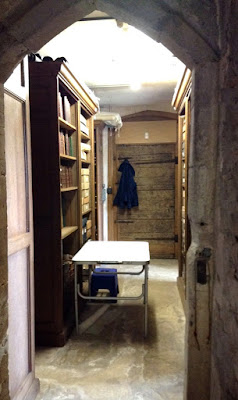
David Smith is the archivist of Berkeley Castle, keeper of over 20,000 documents relating to the upkeep and lives of those connected to the Castle. Mr. Smith began his career as a trainee archivist working in the Bodleian Library at the University of Oxford, under Dr. Richard Hunt after which he spent 35 years as a local authority archivist in Ipswich, Coventry, Lancashire and Gloucestershire. While working as a county archivist in Gloucestershire Mr. Smith aided the current Mr Berkeley by cataloguing the vast archives of the Castle and has since taken a position exclusively working with the Berkeley Castle archives. The Castle archives house a collection of historic documents and books from the Berkeley estates spanning the entire history of the castle from the twelfth to the twentieth century.  The Muniment room, which currently houses the archive, was established by the 8th Earl of Berkeley in 1925 and contains a number of historically significant documents. The earliest ...