Posts

A fine finial

Image
On the first day of the second week at Berkeley, we uncovered a fragment of a decorative finial. Its decorative style and the location of the find suggest that it belonged to the period between the 13th and 14th century. It resembles the Perpendicular Gothic style seen in churches, where bold straight lines and elaborate designs were widely used. Figure 1. Finial with scale Surviving finials with similar designs can also be found today, and quite nearby too! The arch of the Berkeley burial chapel in the neighbouring church of St Mary features a row of finials. This chapel was constructed by James I. Berkeley c.1450, which places it firmly in the period when the Perpendicular Gothic style was popular. Figure 2. The Tomb of King Edward II (photo credit: http://www.geograph.org.uk/photo/2798797) Another example with a similar style can be found in Gloucester Cathedral, decorating the tomb of King Edward II, who was also murdered at Berkeley Castle. This tomb dates to...

Update from the trench: alignment's not just for the stars.

Image
Previous excavations in Berkeley Castle’s butterfly garden (2005 - 2006) and The Berkeley Arms pub (2009) uncovered archaeological evidence for what is believed to be enclosure ditches that mark the outer limits of the Anglo-Saxon Minster precinct. Artefacts such as pottery sherds and several coins from the tenth century assisted in dating the construction of the ditches. These outer enclosure ditches were aligned at 010 ° from the north and are shown on Figure 1 as the outer blue line. However, during further excavations of Trench 8 in 2015, a structure dating to the ninth century was excavated in the south east section of the trench, and found to have an alignment of 356 ° from north . Constructed of robbed Roman masonry, Professor Mark Horton explains that the building was dated to the eighth or early ninth c entury through the excavation of three coins from the reign of Coenwulf, the King of Mercia (796 - 821 CE). Figure 1. A map showing the excavated wall and building, and ...

Back in Berkeley - Stuart Prior returns

Image
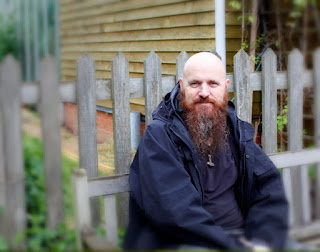
The last eighteen months were challenging for co-Director Stuart Prior. Last year, he was struck by a serious infection that attacked his brain and hospitilised him for an extended period. After operations, physio-therapy sessions, and bucket loads of determination, he was finally able to rejoin the project once more this season. On the first day of the project, he lead our new students on a tour of the Castle and grounds, explaining why he is so fascinated by Berkeley. Stuart spoke with the Engagement Team about his recent health challenges: I was diagnosed with ADEM – swelling of the brain – it’s quite rare. I didn’t realise how bad I was, nobody told me at the time how rare it was. They don’t want to tell you these things, so I didn’t know if I would survive, I didn’t know if I could go back to work.  At one point, they said that I might basically be permanently disabled, I might never be able to drive again, I might never be able to speak again. At one point I ...

The Romans in South West Britain.

Image
The Roman conquest of Britain began under the Emperor Claudius in AD 43. The Roman Army had reached the South West by AD 45-47 under Aulus Plautius (Hornblower and Spawforth, 1998). Until the end of Roman occupation of Britain the South West was a centre of wealth, trade and farming, although as a whole South West Romano-Britain is under researched. It has long been thought that the South West offered a strong resistance to ‘Romanisation’, particularly past the Tamar Valley which separates Devon and Cornwall, and that Cornwall remained largely out of Roman hands throughout the Romano-British period (InfoBritain, 2009). Recent research has refuted this interpretation and remains of Roman settlements have been found throughout the further South West, suggesting that Roman influence extended much further than previously thought. One of the sites which this re-evaluation of the evidence is at Ipplepen, in Devon, where a small settlement found in 2011 along with a coin hoard redrew...

Find of the Day - John Legg Clay Pipe

Image
Our find of the day, the first of the 2017 season, is a fragment of clay tobacco pipe. Fortunately, the bulb end is intact and we can easily read the maker's mark "John Legg". With this clue, we consulted the National Pipe Archive and dated the artefact to sometime between 1700 and 1800. Second year student Tess Kaye made the discovery. John Legg pipes were produced in the small town of Brosley [Broseley], Shropshire. Coal and clay were the town's primary natural resources exploited during the Industrial Revolution. In the eighteenth century, the pipeworks were one of the largest international exporters of clay pipes in Britain. Today,  Broseley Pipeworks form part of a World Heritage Site celebrating this period. The marker's mark is legible on the flattened base (pedestal). While some pipes of the eighteenth century were decorated, this is plain apart from milling marks below the bowl. The dotted pattern along the edge of the bowl was caused by th...

Medieval metal working at Berkeley

Image
One focus of the current excavations in the trench is the uncovering of 15th century buildings at the west end of the trench. These buildings show little evidence of domestic use with their assemblages devoid of the usual cooking pots and other domestic items. They have instead been suggested as industrial buildings used for the working of metal, in other words a possible late medieval smith. This appears to fit with a previous interpretation of the site being used for metal working. Back in 2009 a large rectilinear building (see figure 1) was uncovered that dated to the 16th century. After consideration it was suggested that due to the lack of domestic assemblages this building was a series of separate workshops. Previous students studying Archaeological Science, analysed the soil material surrounding a stone hearth found inside the building and found evidence of copper, lead and zinc among other metals. Fig. 1: Rectangular workshops Evidence of zinc found on the site along with...

Geophysical Survey: How Does It Work?

Image
Over the last few weeks our students (see fig.1) have been undertaking geophysical surveys of the castle grounds under field technician Dr. Philip Rowe using Ground Penetrating Radar. GPR is a non-invasive technique which was selected to gain access to the areas of Berkeley Castle which cannot be excavated. Fig. 1Students using GPR equipment. High frequency radio waves are used by the GPR to detect subsurface features such as walls, buildings and ditches. The GPR system consists of an antenna with wheels, an interface display, a battery and a radar control unit (see fig. 2). The GPR detects buried features by emitting electromagnetic waves from the antenna. The transmitted waves bounce off buried objects, causing them to be reflected back to the GPR (see fig. 3), where the control unit transmits the data from the antenna to the user interface display where it can be viewed. It is commonly thought that GPR allows you to see through the ground like an X-ray. This is a common mi...